

Recently, Xiangzhen Kong, Principal Investigator at the Department of Psychology and Behavioral Sciences and the State Key Laboratory of Brain-Machine Intelligence, Zhejiang University, was invited to serve as an Associate Editor of iScience.
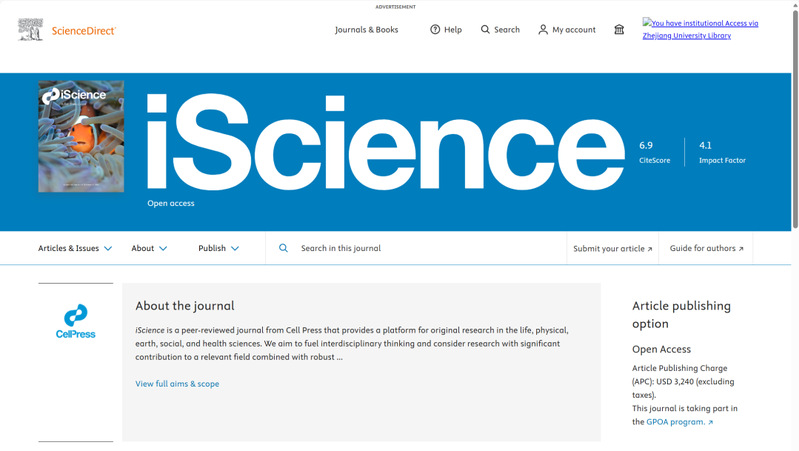
iScience is an international interdisciplinary journal published by Cell Press. The journal provides a broad academic platform spanning the life, physical, earth, social, and health sciences, encouraging researchers to transcend disciplinary boundaries and investigate key principles and mechanisms underlying complex systems from multiple perspectives. As an important platform for Cell Press’s commitment to interdisciplinary science, iScience welcomes original research at the intersections of different disciplines and emphasizes the scientific value of systems thinking, methodological innovation, and disciplinary integration. The journal has a five-year Journal Impact Factor of 4.7 and is ranked Q1 in the JCR, making it an important international publication venue for interdisciplinary research.

Kong has a multidisciplinary background spanning computer science, cognitive neuroscience, and imaging genetics. His research focuses on the brain network basis and computational mechanisms underlying complex human cognitive functions, as well as their applications in areas including psychiatric disorders and brain–computer interfaces.
He has served as principal investigator for projects supported by the National Science and Technology Innovation 2030 Major Project on Brain Science and Brain-Inspired Intelligence, the National Natural Science Foundation of China, and Zhejiang University’s Peak-Building Program for Outstanding Young Scholars (Category A). As first or corresponding author, he has published more than 30 papers in leading international journals, including Proceedings of the National Academy of Sciences (PNAS), Nature Communications, Trends in Cognitive Sciences, and Biological Psychiatry. He also serves as a co-leader of the Lateralization Working Group of the ENIGMA Consortium and has received honors including the Association for Psychological Science (APS) Rising Star Award.