

Recently, the 21st ACM/IEEE International Conference on Human-Robot Interaction (HRI 2026), jointly sponsored by the Association for Computing Machinery (ACM) and the Institute of Electrical and Electronics Engineers (IEEE), was held in Edinburgh, United Kingdom. As one of the most influential international conferences in the field of Human-Robot Interaction (HRI), the conference brought together cutting-edge research from human-computer interaction, robotics, psychology, design, and related disciplines.
In the CORE Conference Rankings, a widely used conference evaluation system in computer science, HRI is rated A* in the areas of Human-Centred Computing and Artificial Intelligence. Published by the Computing Research and Education Association of Australasia (CORE), A* represents the highest ranking and is generally reserved for approximately the top 5%–10% of conferences, indicating outstanding academic influence and international competitiveness within the field.
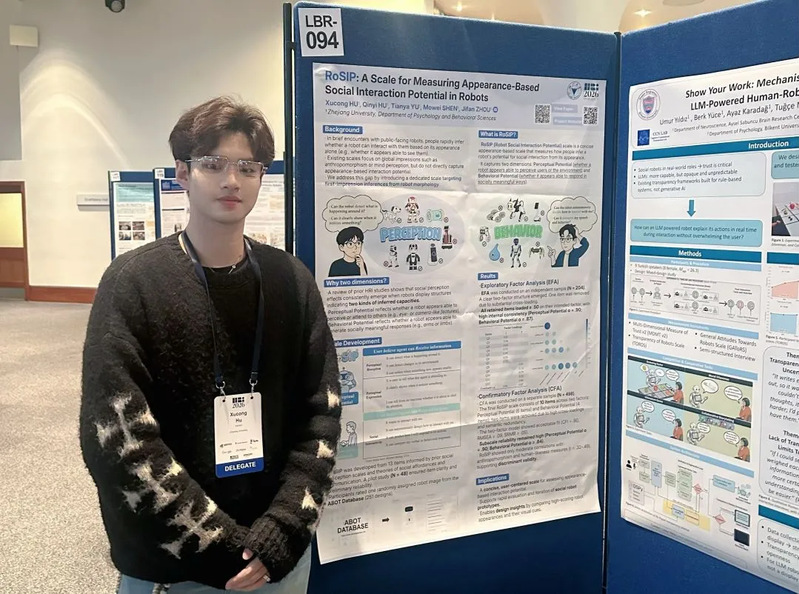
Image: First author Xucong Hu with the conference poster and the Late-Breaking Report Honourable Mention certificate.
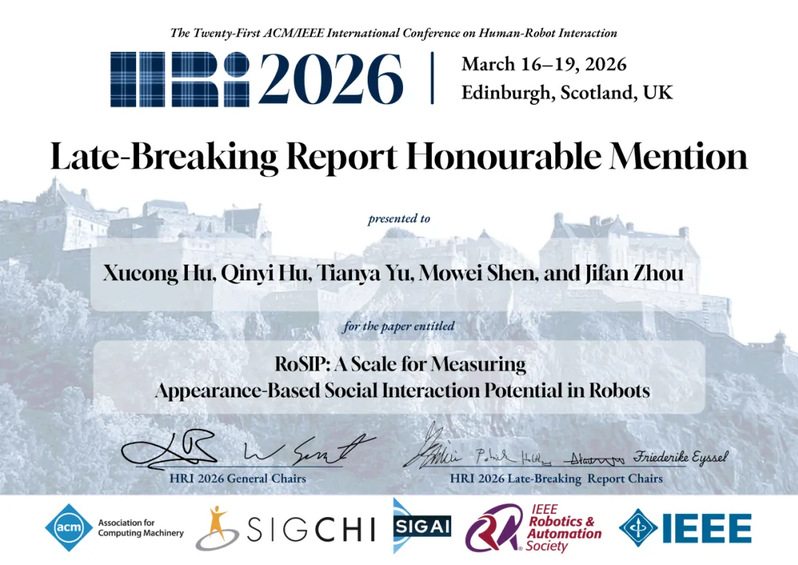
At this year’s conference, the research group led by Professor Jifan Zhou from the Department of Psychology and Behavioral Sciences at Zhejiang University received an Honourable Mention in the Late-Breaking Reports (LBR) track for its work entitled RoSIP: A Scale for Measuring Appearance-Based Social Interaction Potential in Robots. The recognition highlights the originality and academic contribution of the study.
On March 18, Xucong Hu, the first author of the paper, presented the study in a poster session on behalf of the research group. He also engaged in in-depth discussions with researchers from the international academic community and received positive feedback on the work.
About the First Author
Xucong Hu
Xucong Hu is a master’s student in the 2024 cohort at the Department of Psychology and Behavioral Sciences, Zhejiang University.
His research focuses on social cognition in human-robot interaction, including perspective taking and theory of mind. From an interdisciplinary perspective integrating computational and cognitive approaches, he seeks to understand how humans interpret and predict the behavior of socially intelligent agents. As first author, he has published four papers in SSCI-indexed journals, including Cognition and the International Journal of Human-Computer Interaction, and has presented two papers at international conferences including the ACM/IEEE International Conference on Human-Robot Interaction (HRI) and the annual meeting of the Vision Sciences Society (VSS). He has also received honors including the National Scholarship for Graduate Students.
About the Supervisor and Research Group
Professor Jifan Zhou has long investigated human cognitive mechanisms from a computational and theoretical perspective, with a particular focus on the intelligence exhibited by the human cognitive system when solving complex problems. His research centers on working memory and social cognition and has further expanded into human-robot interaction, examining how people infer the social-interaction capabilities of intelligent agents from limited cues. Professor Zhou was selected for the Ministry of Education’s Changjiang Scholars Program for Young Scholars in 2021 and has received a number of academic honors, including the Zhejiang Provincial Natural Science Award.
Building on this central research question, the group has developed a research program integrating cognitive mechanisms, computational modeling, and human-robot interaction. By combining approaches from cognitive psychology and artificial intelligence, the group systematically investigates the mechanisms underlying social cognition in human-robot interaction, providing an important theoretical foundation for understanding natural interactions between humans and artificial agents.
Research Highlights
In everyday interactions with social robots, such as service robots in hotels, people often make rapid judgments about a robot’s capacity for social interaction based on its physical appearance. For example, robots equipped with eyes or camera-like structures may be more readily perceived as capable of “seeing” users, whereas robots with arms may be more readily perceived as capable of behaviors such as waving or shaking hands. Based on this phenomenon, the present study developed a concise measurement tool, the Robot Social Interaction Potential Scale (RoSIP), to assess the social-interaction potential conveyed by a robot’s appearance.
Building on the group’s previous research in social cognition and human-robot interaction, the study further proposed that a robot’s social-interaction potential consists of two key dimensions: Perceptual Potential and Behavioral Potential. These dimensions reflect users’ judgments of whether a robot is capable of perceiving an interaction partner and whether it is capable of producing behavioral responses, respectively. Together, they represent two fundamental prerequisites for basic social interaction.
Methodologically, the study drew on a database of static robot images and recruited a large sample of participants to evaluate the appearances of different robots (N = 750). Factor analyses and related psychometric methods were then used to develop and validate the scale. The final RoSIP consists of 10 items, including six items assessing Perceptual Potential and four assessing Behavioral Potential, and showed good overall reliability and validity in the validation analyses.
The study makes two main contributions. First, RoSIP provides a rapid evaluation tool for the early stages of robot design, enabling designers to assess whether a robot’s appearance effectively communicates its capacity for social interaction during the prototyping stage. This may help enhance user acceptance and willingness to interact with the robot. Second, based on the image-rating and scale data, the researchers developed a systematic database that can be used to identify highly rated robot designs and examine their key visual features, thereby providing a data-driven resource for future robot appearance design.
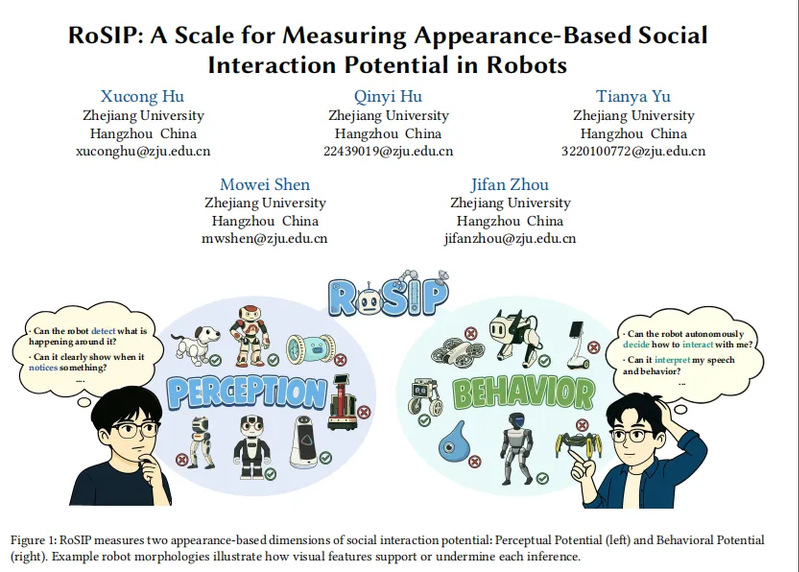
Image: Paper cover and screenshots of the database. The Chinese and English versions of the scale, together with the associated data, are publicly available at https://xuconghu.github.io/ABOT2.0/ for research and design applications.
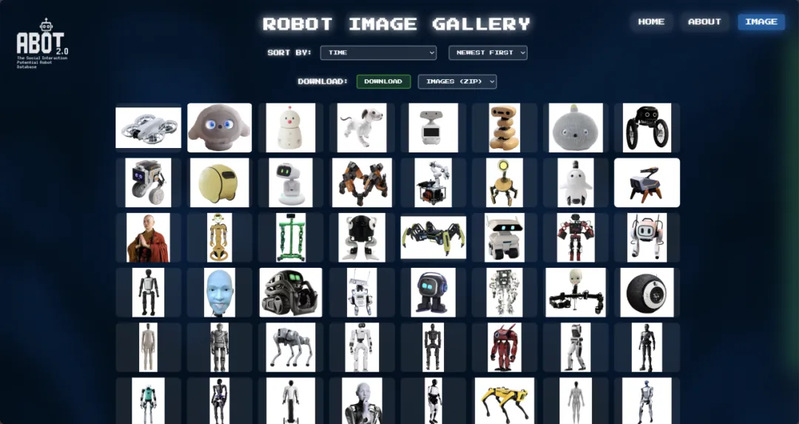
Research Database:
https://xuconghu.github.io/ABOT2.0/
The Chinese and English versions of the scale, together with the associated data, have been made publicly available through the database for research and design applications.
Publication Information
RoSIP: A Scale for Measuring Appearance-Based Social Interaction Potential in Robots
Hu, X., Hu, Q., Yu, T., Shen, M., & Zhou, J. (2026, March). RoSIP: A Scale for Measuring Appearance-Based Social Interaction Potential in Robots. In Companion Proceedings of the 21st ACM/IEEE International Conference on Human-Robot Interaction (pp. 466–470).
Paper:
https://dl.acm.org/doi/abs/10.1145/3776734.3794438
Xucong Hu is the first author and presenting author of the paper, and Professor Jifan Zhou is the corresponding author. The co-authors also include Qinyi Hu, a master’s student in the 2024 cohort, and Tianya Yu, an undergraduate student in the 2022 cohort. The study was jointly supervised by Professors Jifan Zhou and Mowei Shen.
Looking Ahead
Going forward, the research group will further integrate cognitive modeling and artificial intelligence approaches to investigate how humans understand intelligent systems and the mechanisms underlying human–AI interaction. The group aims to advance the application of this research in human–machine collaboration and intelligent-system design, providing theoretical support for the development of more natural and efficient forms of human–machine interaction.