

Recently, Professor Tengfei Wang from the Department of Psychology and Behavioral Sciences and the State Key Laboratory of Brain-Machine Intelligence at Zhejiang University was invited to serve as an Associate Editor of Intelligence.
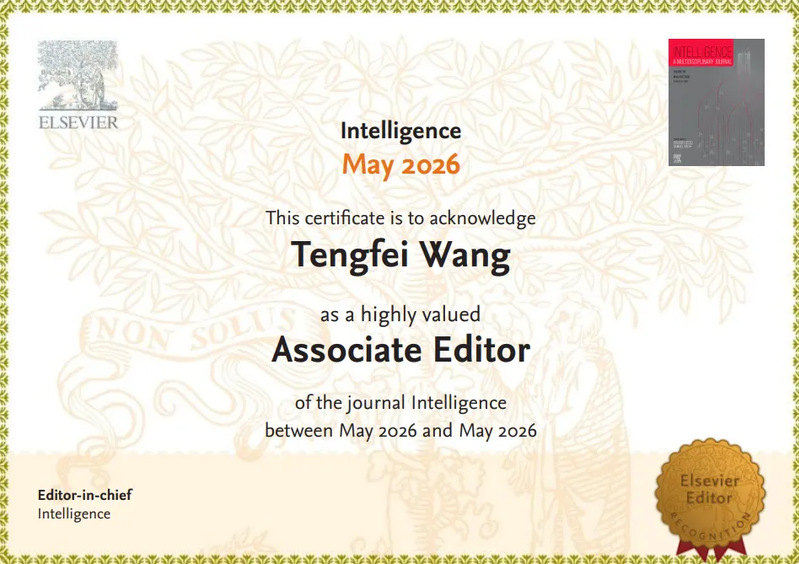
Intelligence is dedicated to advancing the understanding of the nature, structure, measurement, and developmental mechanisms of human intelligence. In addition to examining individual differences in intellectual ability and cognitive performance, the journal places particular emphasis on the psychological, genetic, and social mechanisms underlying the development of intelligence and its contributions to educational achievement, social adaptation, and real-world performance. It values the integration of theoretical, methodological, and empirical research and covers key topics including intelligence assessment, cognitive performance, creativity, personality traits, and real-world achievement. The journal also encourages multidisciplinary approaches to understanding individual differences in human intelligence. Published by Elsevier and specifically devoted to research on intelligence, Intelligence has long served as a leading publication venue in the fields of intelligence and individual differences and is ranked Q1 in the JCR category “Psychology, Multidisciplinary.”
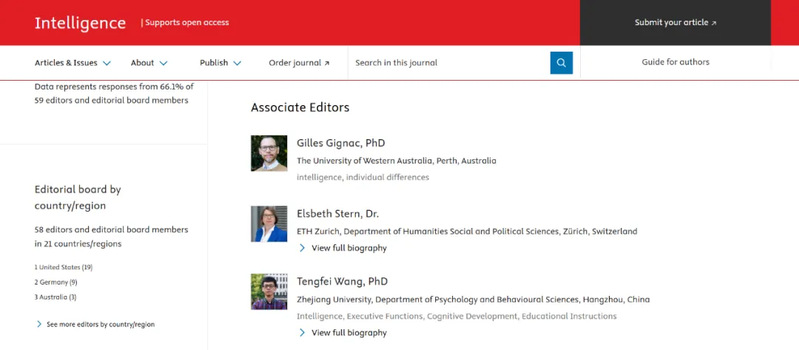
Professor Wang’s research group has long conducted systematic research on executive function, a core component of human cognition. Beyond examining the role of executive function in higher-order cognitive activities, the group seeks to understand the behavioral consequences of failures in executive control, the developmental trajectories and determinants of executive function, and the effects of executive-function impairments on child development.
The group’s research centers on four major scientific questions: (1) How does executive function contribute to higher-order cognitive activities such as intelligence, learning, and problem solving? (2) How does individual behavior change when executive control fails? (3) How does executive function develop, and what factors influence its development? (4) How do impairments in executive function affect child development?