
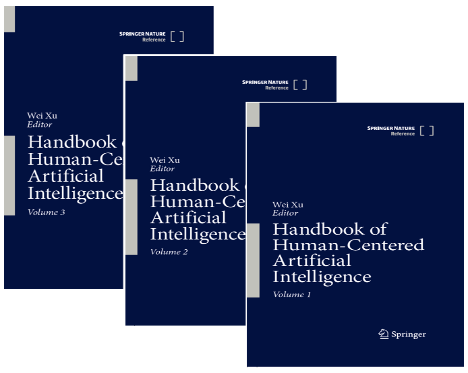
The Handbook of Human-Centered Artificial Intelligence, edited by internationally renowned human factors scientist and distinguished alumnus of the Department, Dr. Wei Xu, has recently been published by the internationally acclaimed publisher Springer and released globally. As the world’s first major English-language reference work in the field of Human-Centered Artificial Intelligence (HCAI) that combines theoretical depth with practical value, this handbook comprises contributions from over 130 cross-disciplinary experts and scholars from more than 10 countries, spanning 59 chapters across three volumes with a total of 2,700 pages. It provides a comprehensive and systematic overview of global advances in HCAI concepts, methodologies, technologies, design, risk management and governance, industry applications, and implementation practices. The handbook aims to further promote global HCAI practice, facilitate the safe and effective development of AI technologies for the benefit of humanity, and mitigate potential adverse effects. Academician Ben Shneiderman, a leading authority in human–computer interaction, has written the foreword, commending the handbook for elevating HCAI research and applications to a new level. Numerous academicians and experts from various countries have also provided endorsements.
---
Book Overview
AI technologies have greatly benefited humanity; however, improper development and use can cause harm. Compared with nuclear energy and biochemical technologies, AI exhibits characteristics such as decentralization, low barriers to entry, and autonomy, which render its control increasingly challenging. Consequently, the responsible development and use of AI becomes all the more critical—hence the emergence of the HCAI field. HCAI systematically integrates cutting-edge AI technologies with the human-centered principles and approaches of human factors science (including engineering psychology, human factors engineering, and human–computer interaction), encompassing human needs, values, capabilities, controllability, user experience, safety, and beyond. It proposes a holistic, human-first philosophy and methodology to guide the design, development, deployment, and application of AI systems, thereby promoting the healthy evolution of AI and its beneficial impact on society. This handbook demonstrates that HCAI has rapidly evolved from an initial concept into a systematic frontier domain that integrates methods, technologies, design, practices, applications, as well as AI risk management and governance approaches. It embodies innovation, systematicity, applicability, and effectiveness. As an interdisciplinary reference work spanning AI, computer science, human–computer interaction, human factors engineering, psychology and behavioral science, design, and related fields, the handbook is suitable for practitioners, researchers, developers, educators, students, and policy makers in AI-related domains. Its publication underscores the significant influence of human factors science in AI technology development and application, as well as the leadership of Chinese scholars in this arena.
Endorsements from Academicians and Experts, and Table of Contents:
https://mp.weixin.qq.com/s/Hf7IzflWjTYxLqzMQ-FLuw
---
Biographical Sketch
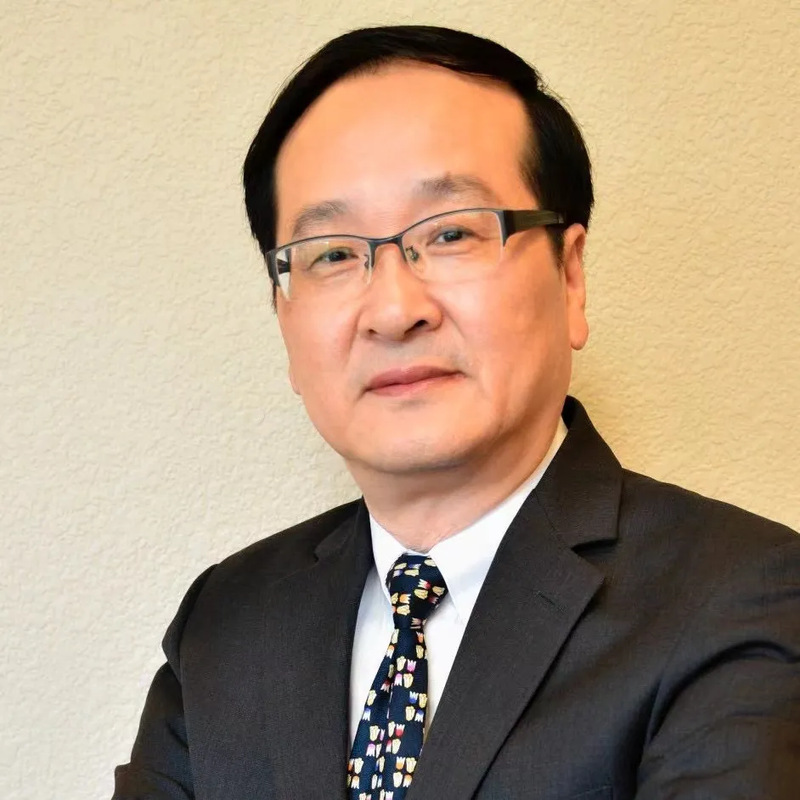
Dr. Wei Xu
Master’s Graduate of the Department of Psychology, Former Hangzhou University, Class of 1988
Dr. Wei Xu has been engaged in human factors research, application, and standards development for nearly four decades. He is currently one of only four scholars worldwide—and the sole scholar of Chinese heritage—to hold the Fellow status concurrently from the International Ergonomics Association (IEA), the Association for Psychological Science (APS), and the Human Factors and Ergonomics Society (HFES). He serves as Chief Scientist at HCAI Labs; Associate Editor of IEEE Transactions on Human-Machine Systems, Senior Editor of IEEE Transactions on Technology and Society, and Editorial Board Member of the International Journal of Human–Computer Interaction, The Interdisciplinary Journal of E-Skills and Lifelong Learning, and the Chinese journal Applied Psychology. He has been listed among Elsevier’s “2025 World’s Top 2% Most Influential Scientists” (which includes 29 mainland Chinese psychologists) and CNKI’s “2025 China’s Top 5% Highly Cited Scholars,” and received the Chinese Association for Artificial Intelligence’s 2021 Outstanding Author Award.
He received his Master’s degree in Industrial Psychology from our Department in 1988, under the supervision of Professor Zhu Zuxiang—a pioneer of engineering psychology in China and a faculty member of the Department of Psychology and Behavioral Sciences, Zhejiang University. He subsequently remained on the faculty of the Department (formerly the Department of Psychology, Hangzhou University) for several years, during which he received multiple awards for major national science and technology projects. In the early 1990s, he pursued further education abroad, earning a Ph.D. in Human Factors Science and a Master’s degree in Computer Science. He has served as Principal Engineer/Senior Researcher in Human Factors Science at leading international IT corporations and as Researcher/Senior Engineer at top-tier international aviation enterprises, with his research outcomes applied in various domestic and international aircraft models and IT systems. He is a member of the ISO Technical Committee on Human-System Interaction (TC159/SC4), where he co-developed and drafted multiple international general and AI-system human factors design standards (including ISO 9241-210/220/810/812, among others). In recent years, he has been dedicated to promoting and researching HCAI and human–AI interaction. In 2019, he proposed the first systematic framework for HCAI internationally; in 2021, he was the first in China to systematically define the emerging field of “human–AI interaction” and published the first book in this domain, Human–AI Interaction, in 2024. He has proposed a series of novel theories and model frameworks, including human–AI teaming, human–AI collaborative cognitive systems, human–AI collaborative cognitive ecosystems, intelligent sociotechnical systems, an HCAI methodological framework, human-centered human–AI interaction, and an HCAI organizational maturity model. His other recent publications include Human-Centered AI: Advancing Research and Applications in Human-AI Interaction, the textbook Engineering Psychology, and User Experience (the first domestic textbook on the subject).
---
Once again, we extend our warm congratulations to Dr. Wei Xu on this internationally leading and significant research achievement, his pioneering work in advancing the new fields of HCAI and human–AI interaction in the intelligent era, and his sustained contributions to the field of human factors science.
---
Reported by Gao Zaifeng
Edited by Zhou Wei
Reviewed by Kong Xiangzhen
Final Approval by Chen Miaofeng