

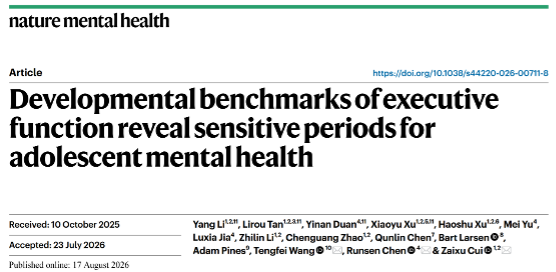
Recently, the team led by Wang Tengfei from the Department of Psychology and Behavioral Sciences at Zhejiang University, in collaboration with the team of Cui Zaitao from the Beijing Institute for Brain Sciences and Brain-Inspired Research, and the team of Chen Runsen from the Vanke School of Public Health at Tsinghua University, published a research article titled “Developmental Benchmarks of Executive Function Reveal Sensitive Periods for Adolescent Mental Health” in Nature Mental Health. Based on data from 33,622 adolescents aged 11–18 years from the Yunfu Qingmiao Project in Guangdong Province, this study delineated the developmental trajectories of working memory and inhibitory control, and further examined the association between individual deviations in executive function development and mental health, as well as the age-related dynamics of this association.
---
Research Background
Adolescence represents a critical period for the rapid maturation of executive function, as well as a significant window during which various mental health problems gradually emerge. However, there remains a lack of normative developmental trajectories for adolescent executive function derived from large-scale population-based samples. Furthermore, systematic knowledge is still limited regarding whether individual performance deviating from age‑normative developmental levels is associated with mental health risks, and whether such associations vary across age stages.
---
Research Methods and Results
1. Developmental Trajectories of Adolescent Executive Function
The study assessed inhibitory control using the Go/No-Go task, and working memory using 1-back and 2-back tasks. The Generalized Additive Models for Location, Scale and Shape (GAMLSS) were employed to establish developmental trajectories at the 5th, 25th, 50th, 75th, and 95th percentiles of executive function (Figure 1).
Results showed that executive function generally improved with age; however, different cognitive components exhibited distinct maturation trajectories. Inhibitory control continued to improve throughout the 11–18-year age range, whereas working memory gradually plateaued in late adolescence. Compared with lower-load working memory tasks, the higher-load 2-back task showed lower performance in early adolescence but exhibited faster improvement with age. Concurrently, interindividual variability in executive function decreased with age, suggesting a gradual stabilization and maturation of executive function during adolescence.
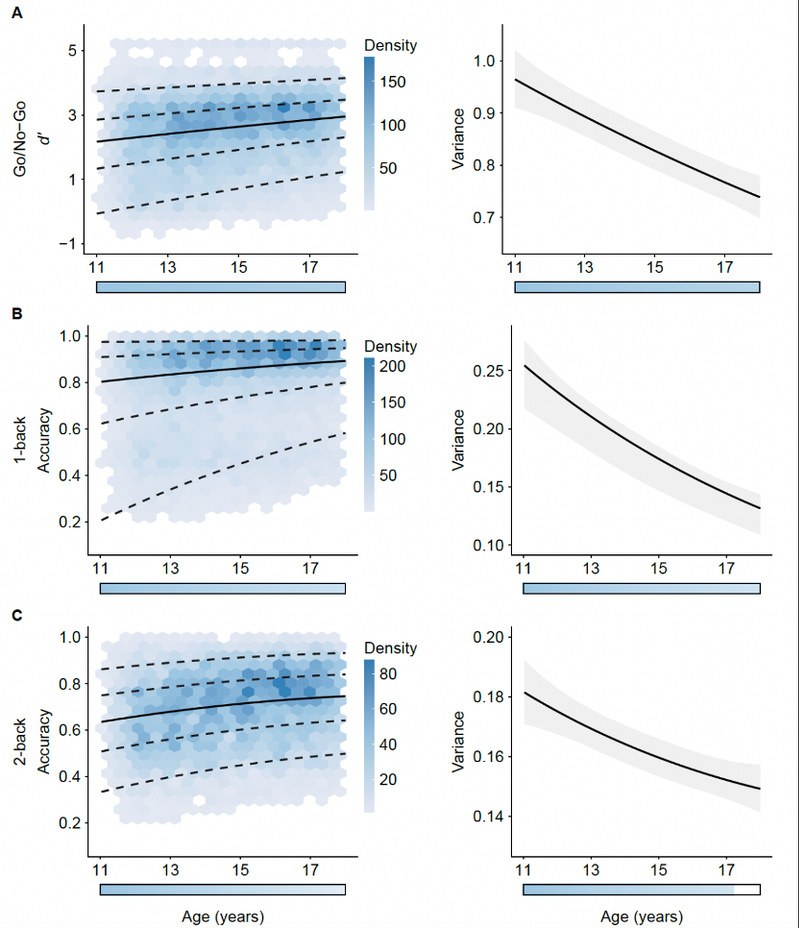
Figure 1. Developmental Trajectories of Adolescent Executive Function
2. Association Between Executive Function and Mental Health Was Strongest in Early Adolescence
Using the established age-and sex-specific reference curves, the study further calculated a deviation score for executive function for each adolescent, reflecting the extent to which their performance deviated from age expectations. Results revealed that adolescents with lower executive function relative to age-normative levels exhibited more peer problems, conduct problems, and hyperactivity/inattention, as well as lower levels of prosocial behavior.
Further age-dynamic analyses indicated that the association between executive function deviation and mental health was not consistent across the entire adolescent period; rather, it was most pronounced in early adolescence and gradually diminished with increasing age. This suggests that early adolescence may represent a developmental sensitive period during which the link between executive function and mental health is particularly strong.
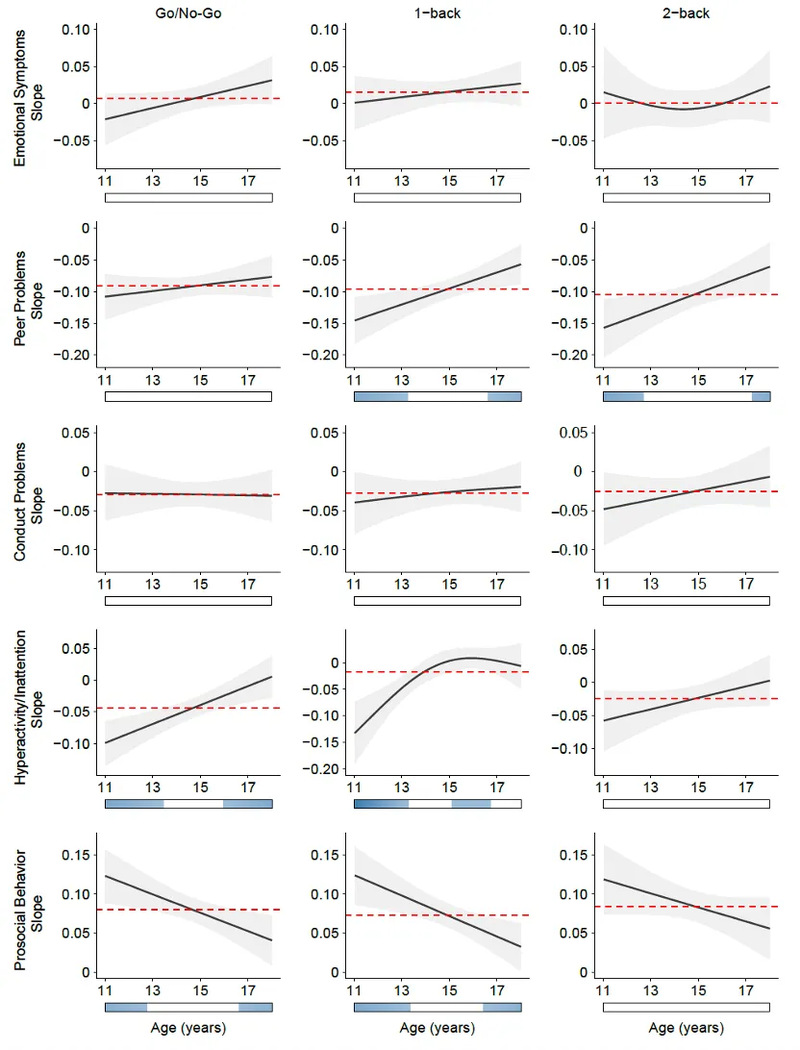
Figure 2. Age‑Dynamics of the Association Between Individual Executive Function Deviation and Mental Health
---
Significance of the Study
This study established developmental benchmarks for executive function based on a large-scale adolescent cohort, revealed distinct maturation trajectories for inhibitory control and working memory, and demonstrated that the association between deviation in executive function development and mental health exhibits significant age-dynamic characteristics, being particularly prominent in early adolescence. The findings provide novel reference standards for understanding the rules of cognitive development in adolescence, implementing individualized assessments of executive function, and identifying mental health risks during critical developmental windows.
---
Authorship Information
Professor Wang Tengfei (Zhejiang University), Associate Professor Chen Runsen (Tsinghua University), and Researcher Cui Zaitao (Beijing Institute for Brain Sciences and Brain‑Inspired Research) are co-corresponding authors. Dr. Li Yang (postdoctoral researcher, Beijing Institute for Brain Sciences), Tan Lirou (doctoral student, Beijing Institute for Brain Sciences), Duan Yinan (doctoral student, Tsinghua University), and Dr. Xu Xiaoyu (postdoctoral researcher, Beijing Institute for Brain Sciences) are co-first authors. Other contributing authors include Xu Haoshu, Yu Mei, Jia Luxia, Li Zhilin, Zhao Chenguang, Chen Qunlin, Bart Larsen, and Adam Pines.
---
Original Article Link
https://www.nature.com/articles/s44220-026-00711-8
Research Group Website
https://person.zju.edu.cn/tfwang
---
Reported by Wang Tengfei
Edited by Zhou Wei
Reviewed by Kong Xiangzhen
Final Approval by Chen Miaofeng