

Recently, Researcher Fang Xia, affiliated with the Department of Psychology and Behavioral Sciences at Zhejiang University and the Key Laboratory of Brain Development, Mental Health, and Well-being of Zhejiang Province, received the 2026 “Early Career Award” from the International Society for Research on Emotion (ISRE). This award is established to recognize early-career scholars who have made outstanding academic achievements and demonstrated significant potential for future development in the field of emotion science. This year, only two scholars worldwide were honored with this award.
According to the official announcement published on the ISRE website, Researcher Fang Xia received this honor in recognition of her innovative and high-quality research program, distinguished by a distinctive cross-cultural perspective and substantial empirical contributions that have consistently advanced the field of emotion science.
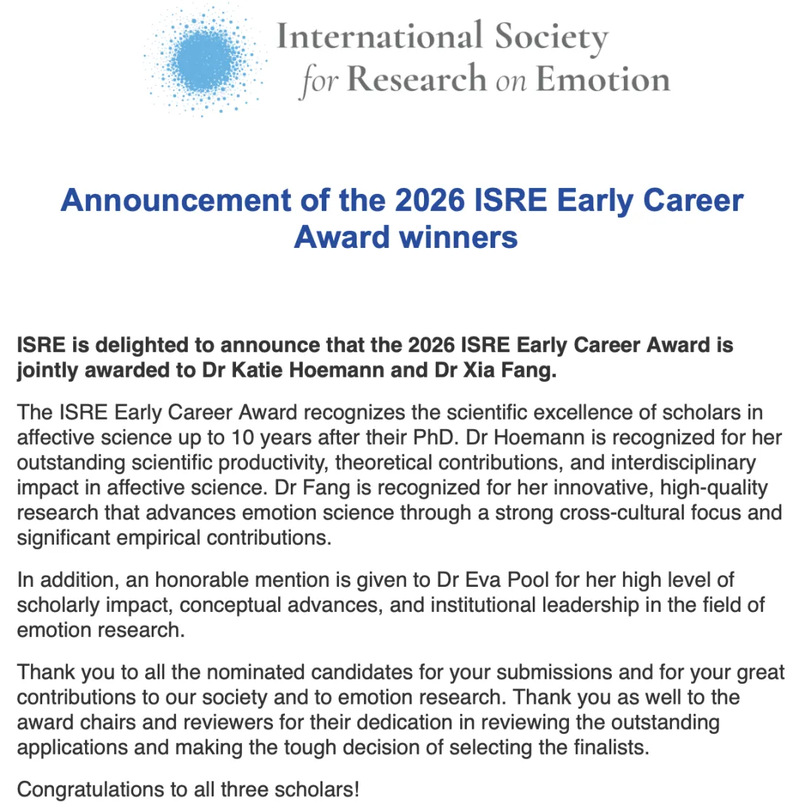
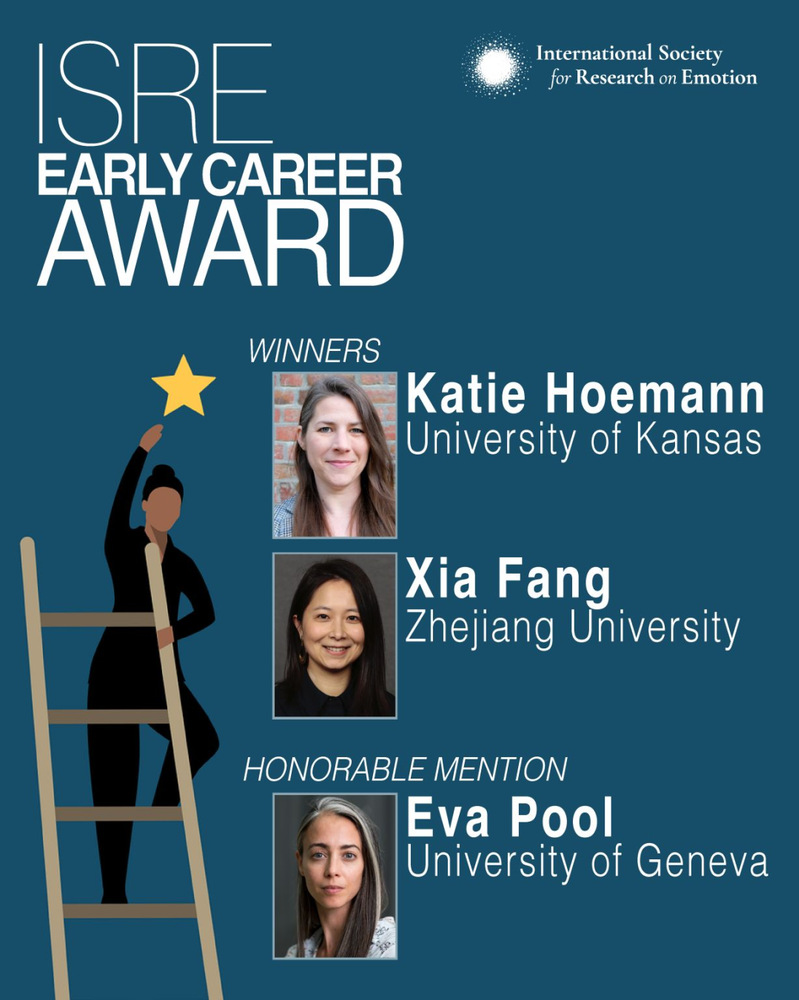
It is reported that Researcher Fang Xia has been invited to deliver an award lecture at the 2026 ISRE Annual Conference and to contribute an invited paper to Emotion Review, a leading international journal in the field of emotion science.
---
About the International Society for Research on Emotion (ISRE)
Founded in 1984, the International Society for Research on Emotion is a highly influential academic organization in the field of emotion research, long dedicated to promoting theoretical development, methodological innovation, and interdisciplinary exchange within the field. The society brings together researchers from diverse disciplines, including psychology, neuroscience, philosophy, linguistics, medicine, computer science, management, sociology, and anthropology. ISRE organizes an international conference biennially, showcasing cutting-edge advances in global emotion research, and launched its flagship journal, Emotion Review, in 2009, providing an important platform for international scholarly communication in emotion science.
---
Faculty Profile

Dr. Fang Xia is a “Hundred Talents Program” Researcher and Doctoral Supervisor at the Department of Psychology and Behavioral Sciences, Zhejiang University. She is a certified expert in the Facial Action Coding System (FACS) and serves as the Principal Investigator of the Emotion and Culture Lab. Dr. Fang’s research focuses on emotion and cultural psychology, with particular interest in how individuals express and perceive emotions through bodily signals such as facial expressions and voice, as well as through artistic forms including music and painting. She systematically examines, from a cross-cultural perspective, how cultural factors shape emotional communication and social cognitive processes. Her relevant findings have been published as first-or corresponding-author papers in internationally renowned journals, including PNAS, Emotion, and the Journal of Experimental Social Psychology. She currently serves on the Editorial Board of the Journal of Cultural Cognitive Science and has led research projects funded by the National Natural Science Foundation of China (Young Scientist Program) and the Hangzhou Municipal Natural Science Foundation (Young Scientist Program).
This award reflects the high recognition of Dr. Fang Xia’s research contributions in the fields of emotion science and cross-cultural psychology by the international academic community, and also demonstrates the sustained development and growing international influence of the Department of Psychology and Behavioral Sciences at Zhejiang University in these research directions.
---
Research Group Website
The Emotion and Culture Lab is currently recruiting postdoctoral researchers. Scholars interested in emotion science, cultural psychology, nonverbal communication, and social interaction research are welcome to join. For specific recruitment requirements and application procedures, please refer to the lab website.
· Dr. Fang Xia’s personal homepage: https://person.zju.edu.cn/xfang
· Emotion and Culture Lab homepage: https://emotionculturelab.com/
---
Reported by Song Weitie and Fang Xia
Edited by Zhou Wei
Reviewed by Chen Miaofeng
Revised on June 22, 2026