

7:00pm Monday 9 May 2022
Online: Zoom
Meeting ID: 818 5128 2372
Passcode: 922625
Invited Speaker
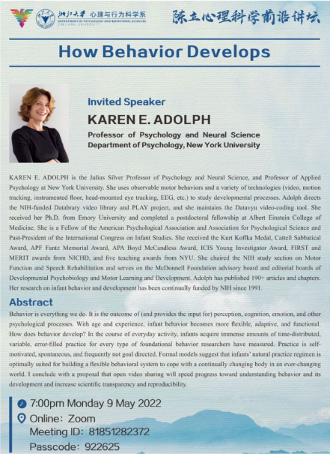
KAREN E. ADOLPH
Professor of Psychology and Neural Science
Department of Psychology, New York University
KAREN E. ADOLPH is the Julius Silver Professor of Psychology and Neural Science, and Professor of Applied Psychology at New York University. She uses observable motor behaviors and a variety of technologies (video, motion tracking, instrumented floor, head-mounted eye tracking, EEG, etc.) to study developmental processes. Adolph directs the NIH-funded Databraryvideo library and PLAY project, and she maintains the Datavyu video-coding tool. She received her Ph.D. from Emory University and completed a postdoctoral fellowship at Albert Einstein College of Medicine. She is a Fellow of the American Psychological Association and Association for Psychological Science and Past-President of the International Congress on Infant Studies. She received the Kurt Koffka Medal, Cattell Sabbatical Award, APF Fantz Memorial Award, APR Boyd McCandless Award, ICIS Young Investigator Award, FIRST and MERIT awards from NICHD, and five teaching awards from NYU. She chaired the NIH study section on Motor Function and Speech Rehabilitation and serves on the James S. McDonnell Foundation advisory board and editorial boards of Developmental Psychobiology and Motor Learning and Development. Adolph has published 199 articles and chapters. Her research on infant behavior and development has been continually funded by NIH since 1991.
Abstract
Behavior is everything we do. It is the outcome of and provides the input for perception, cognition, emotion, and other psychological processes. With age and experience, infant behavior becomes more flexible, adaptive, and functional. How does behavior develop? In the course of everyday activity, infants acquire immense amounts of time-distributed, variable, error-filled practice for every type of foundational behavior researchers have measured. Practice is self-motivated, spontaneous, and frequently not goal directed. Formal models suggest that infants' natural practice regimen is optimally suited for building a flexible behavioral system to cope with a continually changing body in an ever-changing world. I conclude with a proposal that open video sharing will speed progress toward understanding behavior and its development and increase scientific transparency and reproducibility.