

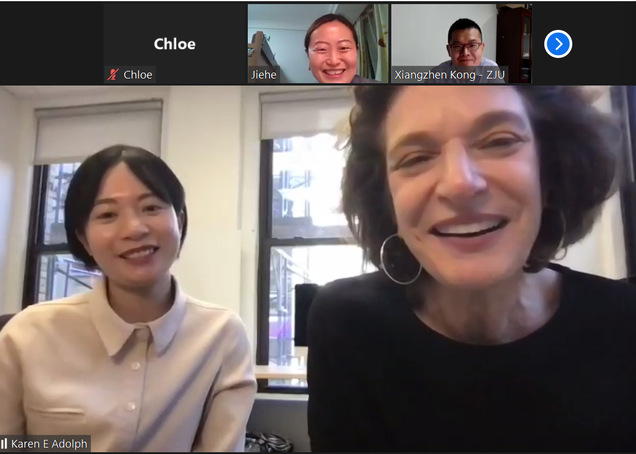
On the evening of May 9th, the first 2022 session of the Chen Li Frontiers in Psychological Science Lecture Series hosted by the Department of Psychology and Behavioral Science was successfully held. This academic event invited Karen Adolph, Julius Silver Professor of Psychology at New York University, to share her research findings and exchange insights online, attracting extensive participation from faculty and students both within and outside the university. Also attending was Karen Adolph's doctoral student, Danyang Han. The forum was chaired by Professor Jie He from the Department of Psychology.
Professor Karen Adolph's presentation, titled How Behavior Develops?, was organized around three sub-themes: behavior, development, and video-based behavioral observation.
01
The Development of Behavior: More Flexible, Effective, and Environmentally Adaptive
Behavior is the collection of all our activities. It is the outcome of perceptual, cognitive, emotional, and other psychological processes, and in turn provides input for them.
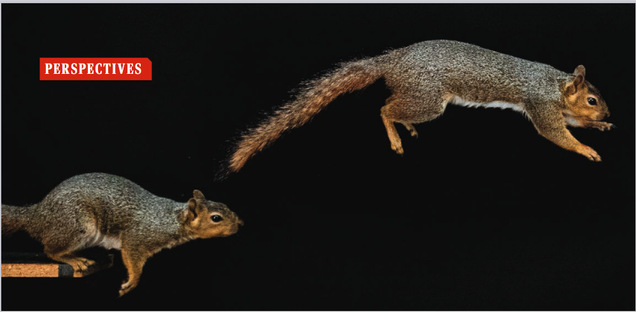
Adolph, K. E. & Young, J. W. (2021). Learning to move in the real world. Science, *373*, 620-621.
Karen Adolph first introduced the characteristics of behavioral development. With age and accumulating experience, infants' behaviors become more flexible, adaptive, and functional. For example, when infants encounter overly steep slopes, excessively wide gaps, or high cliffs, they gradually learn to accurately assess the relationship between their own abilities and the environment as they gain experience, making precise motor decisions. Infants can flexibly adjust their strategies according to environmental characteristics and even discover new ways to accomplish tasks through incidental events. Infant behavior occurs within a context of a continuously growing body and a constantly changing environment.
02
How Does Behavior Develop?
Massive, Variable, Sporadic, and Spontaneous Practice
How does behavior specifically become flexible, effective, and adaptive? A key element in behavioral development is the extensive practice of skills by infants and young children in their daily lives. This daily practice is not fixed or rigid but flexible and variable; it is not concentrated in time but time-distributed; it is not always correct but full of errors. This practice is not primarily directed by parents or the external environment; rather, it is often self-initiated by the child and not necessarily goal-oriented in a strict sense. For infants, movement itself is a reward. Machine learning models suggest that the natural, self-directed skill practice undertaken by infants and young children is precisely the optimal way to learn skills like language and motor actions, which prioritize flexibility and environmental adaptation.
03
Video-Based Behavioral Observation
Karen Adolph posits that the use of video data and recordings will advance psychological research. Recording experimental procedures on video helps enhance research transparency and replicability, thereby accelerating scientific progress. Karen Adolph's team has independently developed Datavyu (www.datavyu.org), a completely free and open-source video coding tool, and created Databrary (nyu.databrary.org), an online platform for storing and sharing video-based research data. Databrary enables the secure, confidential, and ethically compliant sharing of research videos. Using video to document the complete research process increases transparency and the potential for replication, facilitates re-observation of videos to generate new research questions, and simplifies the management and preservation of video records.
Following the captivating presentation, faculty and students actively raised questions on topics such as cross-cultural differences, autism, and cognitive mechanisms. The lively interaction elevated the atmosphere to a high point, and the Frontiers Forum concluded successfully after the discussion.
The Chen Li Frontiers in Psychological Science Lecture Series is one of the academic exchange activities launched by the Department of Psychology this semester for the entire university community, in commemoration of the 120th anniversary of Mr. Chen Li's birth. It aims to share cutting-edge and pioneering academic research. In addition, other activities include the Chen Li Interdisciplinary Forum on Psychological Science, the Chen Li Young Scholars in Psychological Science Forum, the Top Talent Program Research Lecture Series, and the Seminar on Mr. Chen Li's Academic Philosophy. Please stay tuned for subsequent announcements.