
Chen Li Frontiers in Psychological Science Lecture Series: Why I Abandoned Traditional Experimental Psychology After 20 Years
On April 7th, we held the Chen Li Frontiers in Psychological Science Lecture Series and the Psychology (Qiu Shi Science Class) Lunch Exchange. For this event, our department had the honor of inviting Professor Liqiang Huang, Associate Professor from the Department of Psychology at The Chinese University of Hong Kong, as a guest to share and exchange insights with students.
Professor Liqiang Huang's research focuses on visual attention, visual working memory, and visual awareness. In recent years, he has conducted in-depth analyses of various aspects of attention, perception, and cognition by integrating machine learning and conceptual models. Professor Huang completed his undergraduate and master's studies in Optical Engineering at Zhejiang University, earned his Ph.D. in Experimental Psychology from the University of California, San Diego, and conducted postdoctoral research at Princeton University. He has published multiple articles in prestigious journals such as Science, Psychological Review, Nature Human Behaviour, and Psychological Science.
At 2:00 PM, Professor Liqiang Huang delivered a lecture titled Why I Abandoned Traditional Experimental Psychology After 20 Years in Lecture Hall 537 of the Department of Psychology. The lecture was hosted by Professor Hui Chen from our department, attracting hundreds of faculty and students who actively participated, filling the venue to capacity.
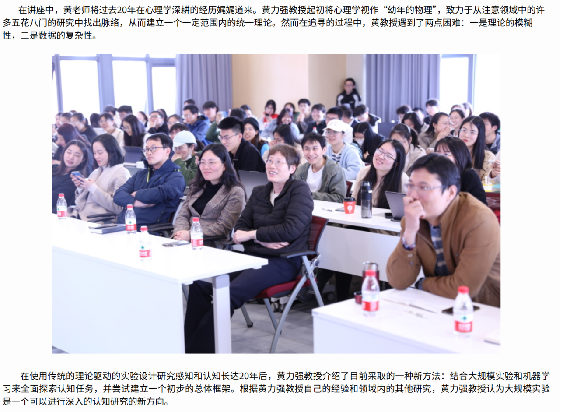
During the lecture, Professor Liqiang Huang thoughtfully shared his experiences from two decades of dedicated work in psychology. He initially viewed psychology as physics in its infancy, striving to identify patterns from the diverse studies in the field of attention to establish a unified theoretical framework within a certain scope. However, during this pursuit, he encountered two major challenges: theoretical ambiguities and data complexity.
After twenty years of employing traditional theory-driven experimental designs to study perception and cognition, Professor Huang introduced a new approach he currently adopts: integrating large-scale experiments with machine learning to comprehensively explore cognitive tasks and attempt to construct a preliminary overarching framework. Based on his own experiences and other research in the field, Professor Huang believes that large-scale experiments represent a promising new direction for in-depth cognitive research.
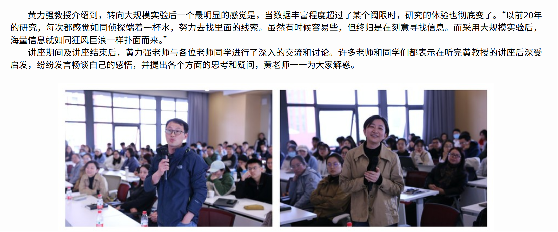
Professor Liqiang Huang explained that after transitioning to large-scale experiments, the most noticeable change was that when data richness exceeds a certain threshold, the research experience becomes fundamentally different. In the past 20 years of research, each study felt like a detective holding a cup of water, diligently searching for clues within. While sometimes it was easier, it always involved deliberately searching for information. However, with large-scale experiments, vast amounts of information overwhelm you like a powerful storm.“
During and after the lecture, Professor Huang engaged in in-depth discussions and exchanges with faculty and students. Many attendees expressed that they were deeply inspired by Professor Huang's presentation, actively sharing their insights and raising questions and reflections on various aspects, all of which Professor Huang addressed in detail.
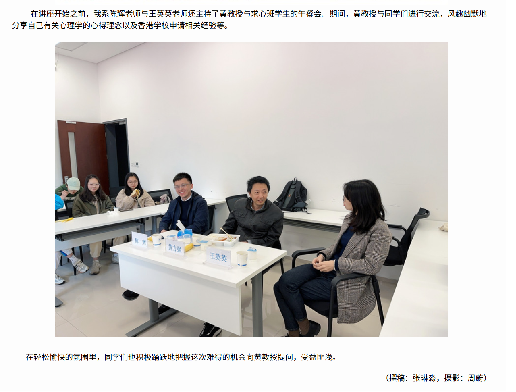
Prior to the lecture, Professor Hui Chen and Professor Yingying Wang from our department hosted a lunch meeting between Professor Huang and students from the Qiu Shi Science Class. During this session, Professor Huang engaged with the students, humorously sharing his insights and perspectives on psychology as well as his experiences regarding applications to Hong Kong universities.
In the light-hearted atmosphere, students actively seized this valuable opportunity to ask Professor Huang questions, gaining substantial benefits from the exchange.
(Writer: Zhang Linmiao | Photographer: Zhou Wei)