

Chen Li Young Scholars in Psychological Science Forum | Academic Report by Dr. Silvia Seghezzi Successfully Held
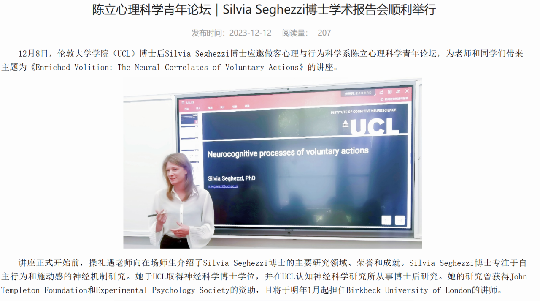
On December 8th, Dr. Silvia Seghezzi, a postdoctoral researcher at University College London (UCL), was invited to the Chen Li Young Scholars in Psychological Science Forum hosted by the Department of Psychology and Behavioral Science. She delivered a lecture titled Enriched Volition: The Neural Correlates of Voluntary Actions for faculty and students.
Before the lecture began, Dr. Liyu Cao introduced Dr. Silvia Seghezzi's main research areas, honors, and achievements to the audience. Dr. Silvia Seghezzi specializes in the neural mechanisms of voluntary actions and the sense of agency. She earned her Ph.D. in Neuroscience from UCL and is currently engaged in postdoctoral research at the UCL Institute of Cognitive Neuroscience. Her work has been supported by grants from the John Templeton Foundation and the Experimental Psychology Society. Additionally, she is set to assume the position of Lecturer at Birkbeck, University of London, starting in January next year.
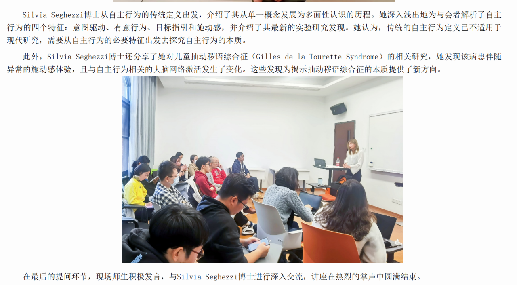
Dr. Silvia Seghezzi began by tracing the traditional definition of voluntary actions, outlining its evolution from a singular concept to a multifaceted understanding. She clearly explained four key characteristics of voluntary actions to the audience: intention-driven, deliberate behavior, goal-directedness, and the sense of agency, while also presenting her latest experimental findings. She argued that the traditional definition of voluntary actions is no longer adequate for contemporary research, emphasizing the need to investigate the essence of voluntary actions based on their fundamental features.
Furthermore, Dr. Silvia Seghezzi shared her research on Gilles de la Tourette Syndrome in children. She found that patients with this syndrome experience an abnormal sense of agency and exhibit altered activation in brain networks associated with voluntary actions. These discoveries provide new directions for understanding the nature of Tourette Syndrome.
During the final Q&A session, faculty and students actively raised questions and engaged in in-depth discussions with Dr. Silvia Seghezzi. The lecture concluded successfully amid warm applause.