

Chen Li Young Scholars in Psychological Science Forum: Applying Computational Theories to Inform Psychopathology
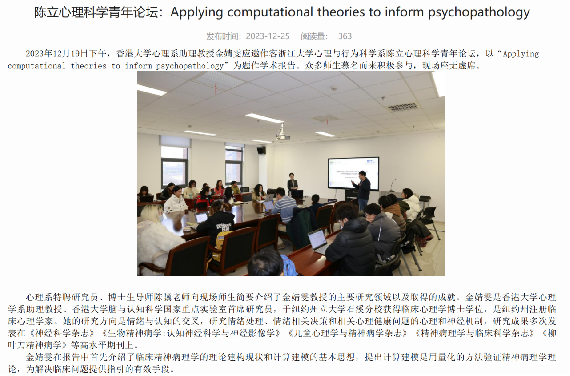
On the afternoon of December 19, 2023, Assistant Professor Jingwen Jin from the Department of Psychology at The University of Hong Kong was invited to the Chen Li Young Scholars in Psychological Science Forum hosted by the Department of Psychology and Behavioral Science at Zhejiang University. She delivered an academic report titled Applying Computational Theories to Inform Psychopathology. The event attracted numerous faculty and students, resulting in a full house.
Distinguished Research Fellow Ji Chen, Doctoral Supervisor at the Department of Psychology, briefly introduced Professor Jingwen Jin's main research areas and achievements to the audience. Jingwen Jin is an Assistant Professor in the Department of Psychology at The University of Hong Kong and a Principal Investigator at the State Key Laboratory of Brain and Cognitive Science at The University of Hong Kong. She earned her Ph.D. in Clinical Psychology from Stony Brook University, State University of New York, and is a licensed clinical psychologist in New York State. Her research focuses on the intersection of emotion and cognition, investigating the psychological and neural mechanisms of emotional processing, emotion-related decision-making, and associated mental health issues. Her work has been published in high-impact journals such as the Journal of Neuroscience, Biological Psychiatry: Cognitive Neuroscience and Neuroimaging, Journal of Child Psychology and Psychiatry, Journal of Psychopathology and Clinical Science, and The Lancet Psychiatry.
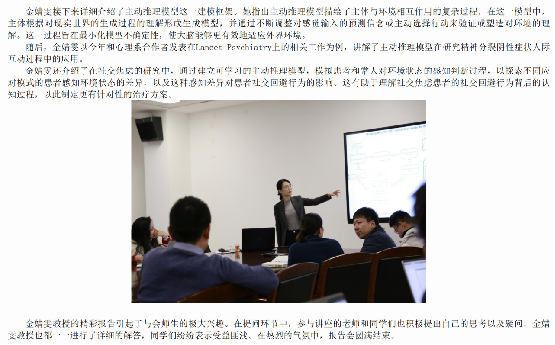
In her presentation, Jin began by outlining the current state of theoretical frameworks in clinical psychopathology and the fundamental concepts of computational modeling. She proposed that computational modeling serves as a quantitative method to validate theories of psychopathology, offering an effective approach to addressing clinical challenges.
Jingwen Jin then provided a detailed introduction to the active inference model as a modeling framework. She pointed out that the active inference model depicts the complex process of interaction between an agent and its environment. In this model, the agent forms a generative model based on its understanding of the generative processes in the real world, continuously refining its predictive beliefs about sensory inputs or actively selecting actions to verify and shape its understanding of the environment. This process aims to minimize model uncertainty, enabling the brain to adapt more effectively to the external environment.
Subsequently, Jingwen Jin used her collaborative work with researchers from the Department of Psychology, published this year in Lancet Psychiatry, as an example to explain the application of the active inference model in studying interpersonal interactions related to negative symptoms of schizophrenia.
Jingwen Jin also discussed her research on social anxiety, where a learnable active inference model was developed to simulate how patients and healthy individuals perceive and judge environmental states. This approach explores differences in environmental state perception among patients with different coping patterns and how such perceptual differences influence patients' social avoidance behaviors. This helps elucidate the cognitive processes underlying social avoidance behaviors in individuals with social anxiety, thereby informing the development of more targeted treatment plans.
Professor Jingwen Jin's engaging presentation sparked significant interest among the attending faculty and students. During the Q&A session, participants actively raised their thoughts and questions, all of which Jingwen Jin addressed in detail. Students expressed that they benefited greatly from the exchange. The event concluded successfully in a lively atmosphere.