

On the afternoon of April 26, 2024, the Chen Li Frontiers in Psychological Science Lecture Series hosted by the Department of Psychology and Behavioral Science of Zhejiang University was successfully held in Classroom 105, North 3 Teaching Building, Zijingang Campus. The event featured Alain LANCELOT, President of the French Chapter of the International Society of Nature and Forest Medicine (INFOM), who delivered an academic lecture titled Stress management and the real health benefits of nature in the prevention of burn-out and depression.
Nature therapy has gained widespread attention in the field of mental health in recent years. Alain LANCELOT is an author, international speaker, coach, and psychological regulator dedicated to stress management, and has published 12 books on nature therapy. The lecture was chaired by Professor Shulin Chen from the Department of Psychology, specializing in clinical psychology. The topic attracted students from various disciplines such as psychology, medicine, architecture, and art, creating a lively atmosphere at the venue.
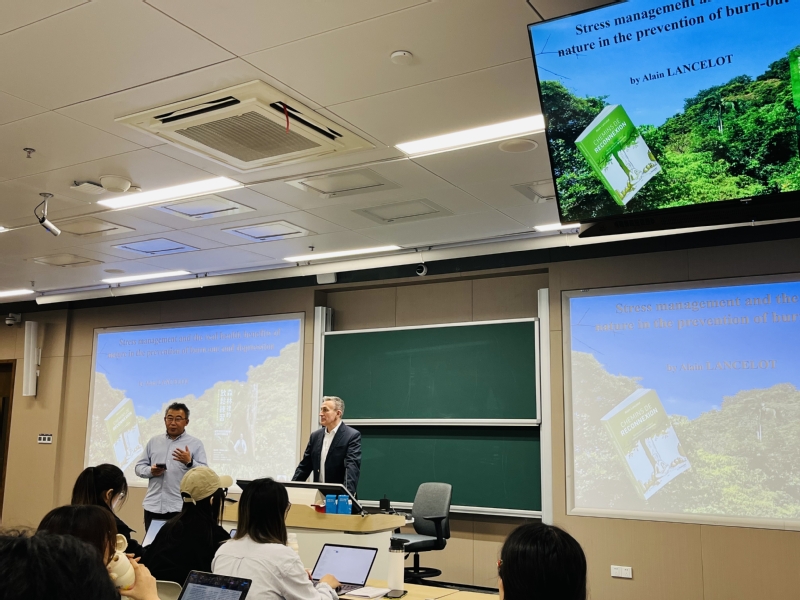
During the lecture, Alain LANCELOT first discussed the importance of nature therapy, pointing out the current disconnection between people and nature in society and introducing the concept of human biophilia. He then elaborated on the benefits of nature and forest therapy, specifically covering five aspects: reducing stress hormones, enhancing the immune system, altering brain activity to manage depression, improving concentration, and enhancing sleep quality. Subsequently, he introduced the three developmental stages of forest therapy, starting from Dr. Qing Li's research in Japan in the 1980s, followed by studies on blood pressure in the 1990s, and research on the immune system's response in 2005. He emphasized the conceptualization of forest medicine as a new preventive medical science and its ongoing research.
Regarding the practice of forest therapy, Alain LANCELOT proposed a six-step approach to reconstruct the connection with nature and oneself, and led the audience through a virtual nature practice session. The specific steps include: disconnecting from the internet and electronic devices; releasing physical tension through methods like muscle relaxation; reconnecting with oneself through abdominal breathing and sensory awakening; liberating the mind through mindful walking and falling leaf exercises; integrating with nature through metaphors; and enhancing awareness through visualization techniques to return to daily life. Detailed steps can be further explored in Alain LANCELOT’s newly published book Relaxation Exercises in the Forest (his first book in Chinese, while his other works are in French).
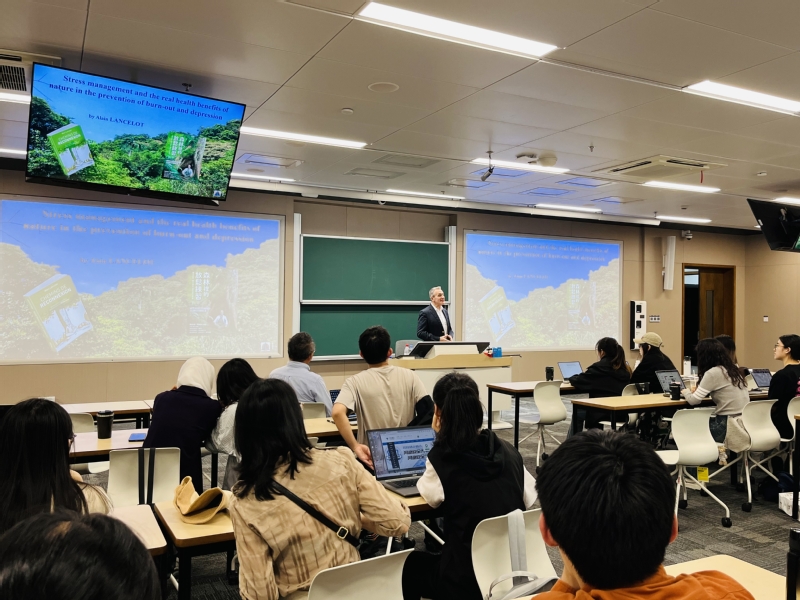
During the interactive session of the lecture, students actively asked questions, demonstrating strong interest and profound reflection on forest therapy. The questions covered various aspects, including practical methods of forest therapy, precautions, and how to integrate forest therapy into daily life. Mr. Alain patiently addressed each query, providing abundant information and practical suggestions.
This lecture not only provided students with scientific evidence regarding nature therapy but also deepened their awareness and understanding of forest therapy through practical experience. It also offered practical guidance on how to find balance in modern life. As Alain LANCELOT emphasized, nature is not merely a pleasant addition to life but an essential healing resource when facing life's pressures—one that we must learn to embrace and utilize effectively.