

On the morning of May 13th, the Chen Li Frontiers in Psychological Science Lecture Series, hosted by the Department of Psychology and Behavioral Science at Zhejiang University, was successfully held in Lecture Hall 537, Building 3, Hainayuan, Zijingang Campus. The event featured Professor Paul L. Harris, the Victor S. Thomas Professor of Education at the Harvard Graduate School of Education, as the keynote speaker. He shared his research findings on children's attachment theory and social cognitive development, exploring cutting-edge studies on theory of mind. Professor Harris is a Fellow of the American Academy of Arts and Sciences, the Association for Psychological Science, and the British Academy. He has served as an editorial board member for top-tier international journals such as Child Development and Human Development. He and his team have demonstrated exceptional research capabilities in the fields of child cognition, emotion, and attachment. The lecture was chaired by Professor Jie He.
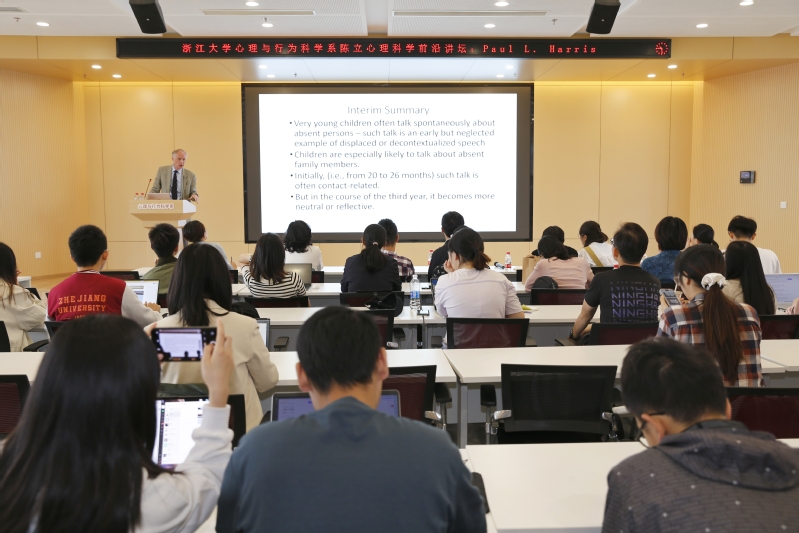
During the lecture, Professor Harris first introduced two contrasting perspectives in traditional attachment theory. Bowlby and others proposed that infants and young children invariably go through three stages—protest, despair, and detachment—when facing separation from their caregivers. However, Robertson and colleagues, based on findings from the Strange Situation Test, demonstrated that when a primary caregiver leaves, if other attachment figures remain with the child, the frequency of negative and anxious reactions significantly decreases, allowing the child to cope with separation more calmly. Consequently, children's responses and understanding of permanent separation from attachment figures, such as in the context of death, became a worthwhile research question.
Over the past few years, Professor Harris has focused on children's psychological developmental processes following the death of a loved one, observing how children discuss the deceased with other relatives or friends. His work reveals how children's understanding of separation and death evolves across different age groups. Findings from a cross-cultural study indicate that, whether in Chinese or English contexts, children as young as 24 months old keep an absent caregiver in mind and spontaneously talk about them with other caregivers, directly expressing their longing through calling for them or asking about their whereabouts. As children grow older, those past the age of three tend to refer to the departed caregiver using more reflective expressions.
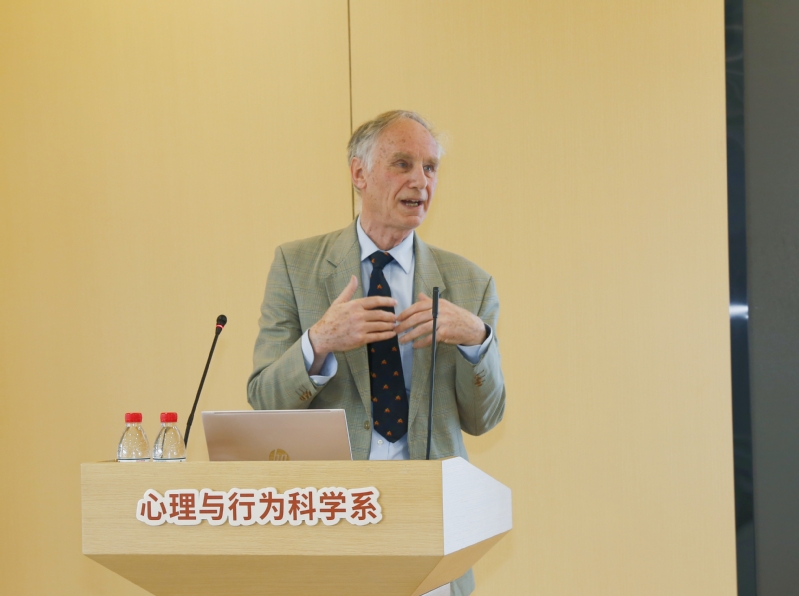
Previous research has suggested that both children and adults easily interpret the death of a loved one as a biological endpoint, terminating any possibility of continuing the relationship. However, in the eyes of a child, death is also a form of separation—one that may mend and sustain past familial bonds in altered ways. For instance, the act of talking itself serves as a form of comfort, as if the departed loved one remains present. Professor Harris argues that this demonstrates young children's capacity to reflect on the absence of members within their social network.
The lecture was rich in content and well-structured, prompting deep reflection among the audience. Through this presentation, attendees gained a novel perspective on children's attachment theory and the development of their psychological understanding of death, providing significant inspiration for future learning and research.