

On October 11th, the Chen Li Frontiers in Psychological Science Lecture Series, hosted by the Department of Psychology and Behavioral Science of Zhejiang University, was successfully held in Lecture Hall 537, Building 3, Hainayuan, Zijingang Campus. The event featured Professor Jerome Busemeyer, a Fellow of the American Academy of Arts and Sciences and a Distinguished Professor at Indiana University, USA. The lecture was chaired by Dr. Junyi Dai, a Research Fellow from the Department of Psychology and Behavioral Science, and attracted a full house of faculty and students from various disciplines including psychology, physics, management, and philosophy, as well as teachers from sister institutions and overseas universities, all gathered for academic exchange.
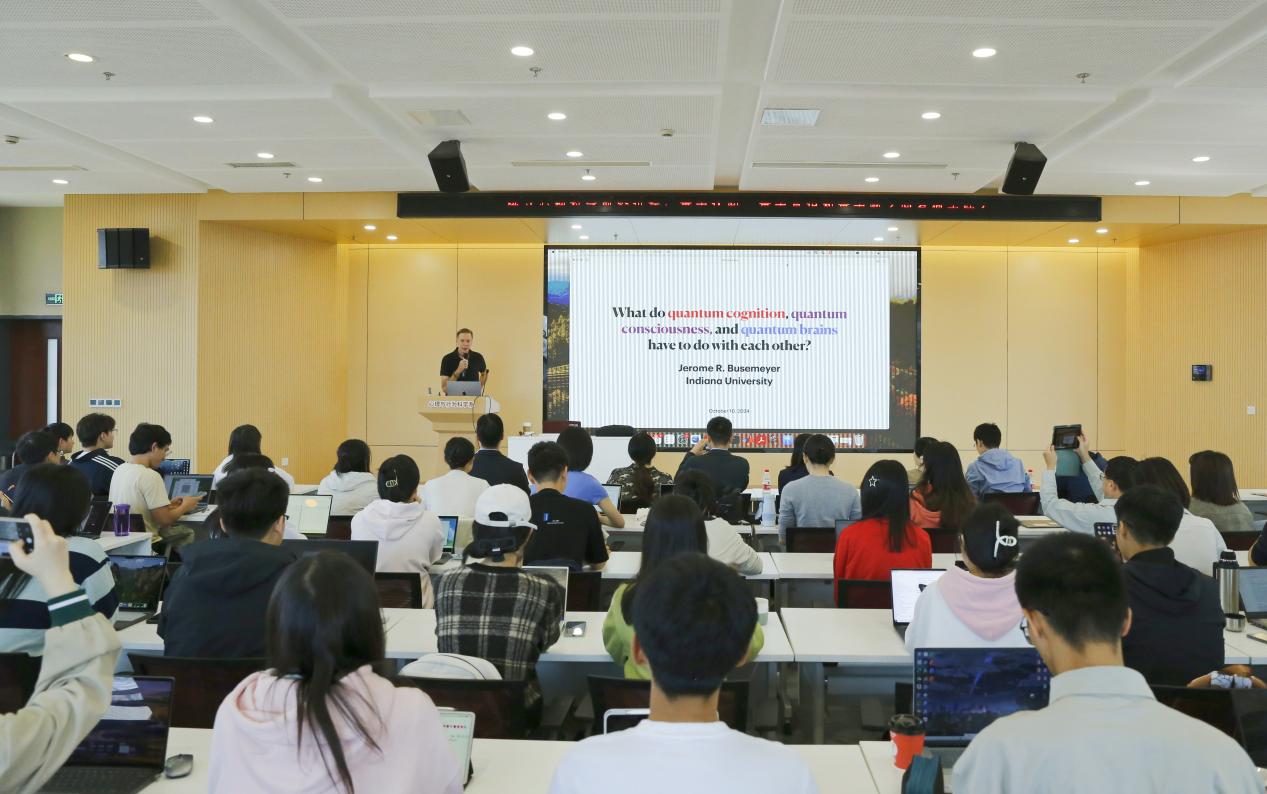
Professor Busemeyer is an internationally renowned psychologist and cognitive scientist in the field of decision-making. In 1993, he proposed the Decision Field Theory, which introduced dynamic stochastic modeling into decision-making research and has profoundly influenced the international scientific community's understanding of human decision-making over the subsequent three decades. Currently, he has also become a pioneering figure in Quantum Cognition—an interdisciplinary approach that applies the mathematical principles of quantum mechanics to psychological research to understand human cognition—and is simultaneously conducting groundbreaking research in the cutting-edge field of Quantum and Consciousness.
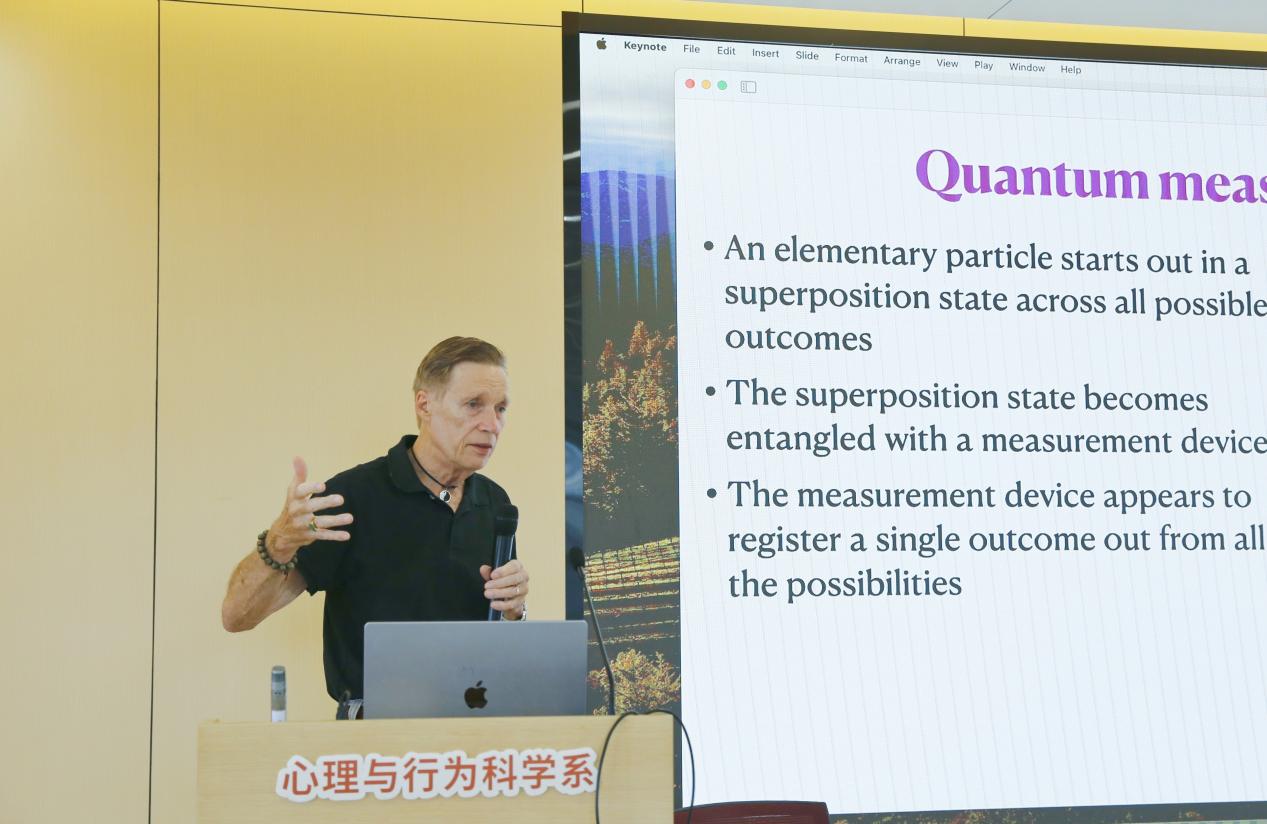
Centered around a series of highly forward-looking scientific questions, Professor Busemeyer delivered a report titled How are Quantum Cognition, Quantum Consciousness, and the Quantum Brain Related? He began with the scientifically valuable yet controversial topics of quantum consciousness and the quantum brain, systematically reviewing the viewpoints and theories of various experts and scholars since the birth of quantum mechanics. This included perspectives from Von Neumann, the proposer of quantum probability theory, the renowned physicist and Nobel laureate Penrose, as well as experts from related fields such as physiology, including Hameroff. Although the relationship between quantum physics and consciousness, and whether quantum phenomena could exist in noisy environments like the human brain remain highly debated, the introduction and analysis of these ideas significantly promote more effective discussions. Subsequently, Professor Busemeyer systematically introduced the related concepts and ideas of quantum cognition, allowing the audience to appreciate the immense potential of introducing quantum probability theory into decision-making and cognitive research, and delving into profound questions about what constitutes rationality. Finally, Professor Busemeyer shared his views on how quantum consciousness and the quantum brain could provide a material foundation for quantum cognitive models, and how quantum cognition research could contribute more evidence to discussions on quantum consciousness.
The report was exceptionally rich in content, featuring both novel theoretical achievements supported by rigorous empirical research and enlightening collisions of cutting-edge viewpoints. After the presentation, faculty and students exchanged views with Professor Busemeyer on various questions of interest, such as the complexity of quantum cognitive theory and whether traditional computers or quantum computers still in development could possess consciousness. Professor Busemeyer elaborated on his perspectives and proposed several important future research directions. To conclude the event, Professor Hui Chen, Deputy Head of the Department of Psychology and Behavioral Science, presented a commemorative gift to Professor Busemeyer, and the lecture concluded amidst warm applause.