

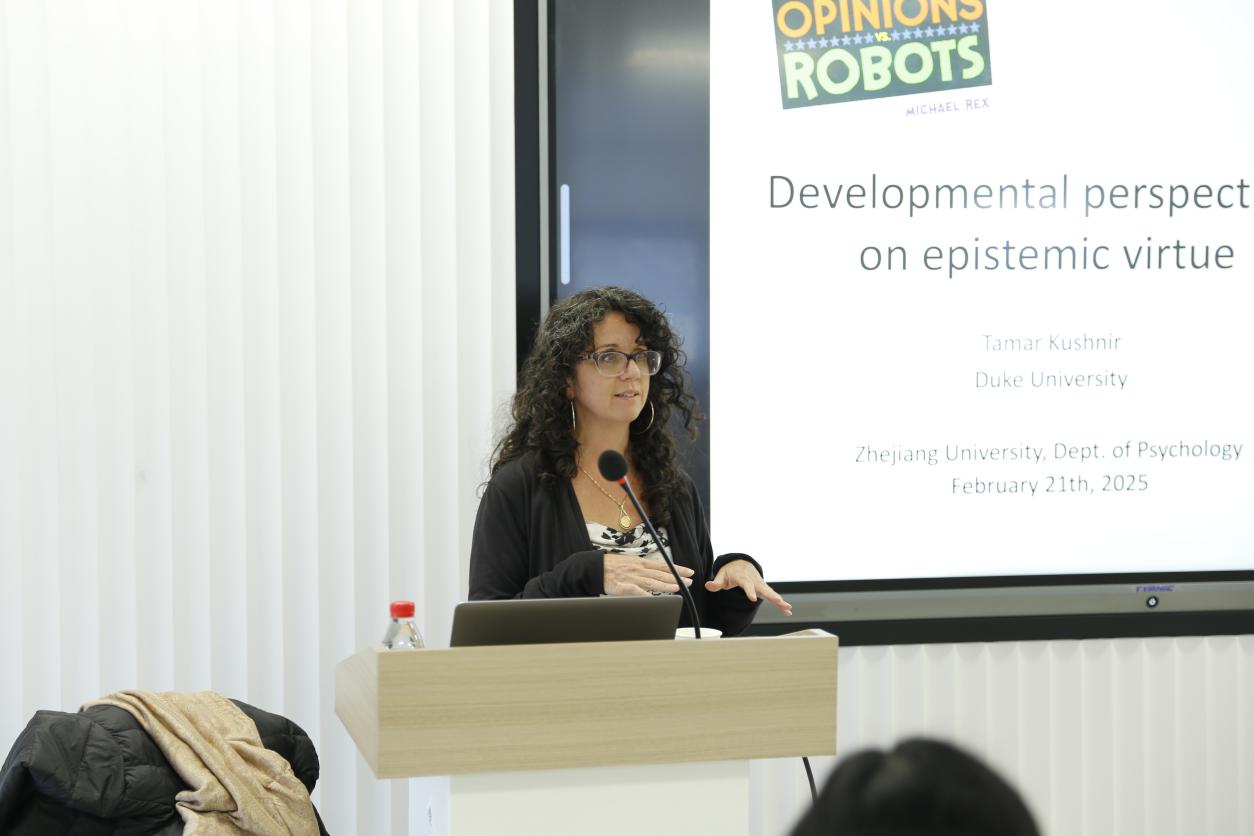
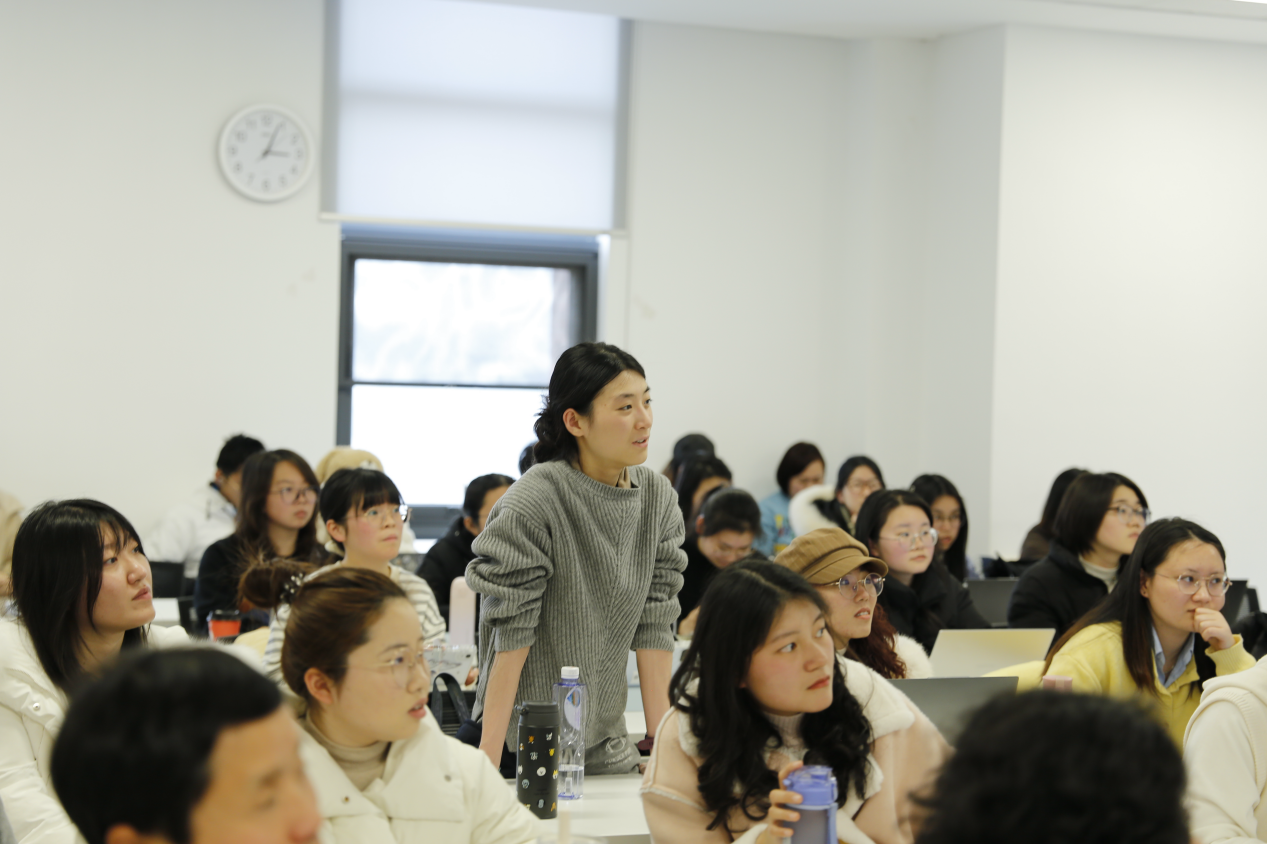
On the afternoon of February 21st, Professor Tamar Kushnir from the Department of Psychology and Neuroscience at Duke University and Director of the Early Childhood Cognition Laboratory was invited to attend the Chen Li Frontiers in Psychological Science Lecture Series at the Department of Psychology and Behavioral Science of Zhejiang University. She delivered an academic lecture titled Developmental Perspectives on Epistemic Virtue in Room 417. The lecture was hosted by Dr. Danyang Han, a Zhejiang University 100-Talent Program Research Fellow, and actively attended by faculty and students from the Department. It also attracted participants from East China Normal University, Hangzhou Normal University, Zhejiang University of Technology, and other institutions, with the venue filled to capacity.
Professor Tamar Kushnir's lecture focused on the concept of Epistemic Humility. Epistemic humility refers to the recognition of one's own cognitive limitations, accompanied by an attitude of humility and openness. Professor Kushnirproposed that when children receive information from the external world, they not only assess the truthfulness and usefulness of the information but also evaluate the cognitive traits of the information provider.
How do children perceive whether those providing them with information possess epistemic humility? Through a series of studies, Professor Tamar Kushnir delved into children's understanding of epistemic humility. Her research found that as children grow, they are willing to trust those who acknowledge the limitations of their own knowledge. For example, children are more inclined to believe subsequent confident statements from someone who has previously admitted I don't know, rather than from someone who is always confidently incorrect. This indicates that children do not view admitting ignorance as a lack of competence, but rather as an objective acknowledgment of the boundaries of knowledge. Additionally, as children age, they show greater appreciation for those who exhibit hesitation and uncertainty in moral dilemmas, suggesting that children can understand and respect the boundaries and complexity of knowledge. Furthermore, children believe that people rationally update their beliefs when confronted with counterevidence—that even firmly held beliefs can be revised in light of new evidence. This further demonstrates that between the ages of 3 and 9, children gradually develop a deeper understanding of epistemic humility, which helps them construct humble, open, and rational cognitive strategies in complex information environments.
The lecture was exceptionally rich in content, showcasing not only theoretical innovations supported by rigorous empirical research but also providing highly inspiring practical insights. Professor Tamar Kushnir's explanations made complex and profound psychological theories accessible and engaging for the faculty and students present, sparking active discussion. Attendees deeply interacted with Professor Kushnir on questions of interest, which not only enhanced their understanding of the lecture content but also stimulated their interest in further exploration and research in the field of child cognitive development.
The event concluded on a perfect note with Professor Tamar Kushnir posing for a group photo with the attending faculty and some of the students.