

【Time】 Friday, July 19, 2024, 9:30 AM
【Venue】 Lecture Hall 537, Building 3, Hainayuan, Zijingang Campus
【Host】 Professor Hui Chen, Deputy Head and Yangtze River Scholar Distinguished Professor of the Department of Psychology and Behavioral Science

Speaker: Jan Theeuwes
Professor, Vrije Universiteit Amsterdam
Fellow, Royal Netherlands Academy of Arts and Sciences
Organized by:
Office of Global Engagement · Department of Psychology and Behavioral Science
The current presentation introduces a tripartite framework for understanding attentional control, highlighting the interaction and competition among top-down, bottom-up and selection-history influences. We explore recent behavioral, EEG, and MRI studies, finding that selection history continuously adapts the weights from a spatial priority map, which dynamically governs attention deployment. Locations containing relevant information are upregulated, while locations containing distracting information are down-regulated. Selection follows the priority landscape formed by current goals and bottom-up saliency, with priority weights influenced by previous selection.
Topic
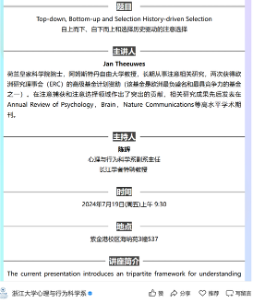
Top-down, Bottom-up and Selection History-driven Selection
Speaker
Jan Theeuwes
Fellow, Royal Netherlands Academy of Arts and Sciences
Professor, Vrije Universiteit Amsterdam
Professor Jan Theeuwes has long been engaged in attention-related research and has twice been awarded the prestigious Advanced Grant from the European Research Council (ERC)—one of the most renowned and competitive funding schemes in Europe. He has made outstanding contributions to the fields of attention and attentional selection, with related research findings published in high-level academic journals such as Annual Review of Psychology, Brain, and Nature Communications.
Host
Hui Chen
Deputy Head, Department of Psychology and Behavioral Science
Yangtze River Scholar Distinguished Professor
Time
Friday, July 19, 2024, 9:30 AM
Location
Lecture Hall 537, Building 3, Hainayuan, Zijingang Campus
Lecture Abstract
The current presentation introduces an tripartite framework for understanding attentional control, highlighting the interaction and competition among top-down, bottom-up, and selection-history influences. We explore recent behavioral, EEG, and fMRI studies,finding that selection history continuously adapts the weights within a spatial priority map, which dynamically governs attention deployment. Locations containing relevant information are up-regulated, while locations containing distracting information are down-regulated. Selection follows the priority landscape formed by current goals and bottom-up saliency, with priority weights influenced by previous selection.