

【Time】 Friday, October 11, 2024, 9:30
【Location】 Lecture Hall 537, Building 3, Hainayuan, Zijingang Campus
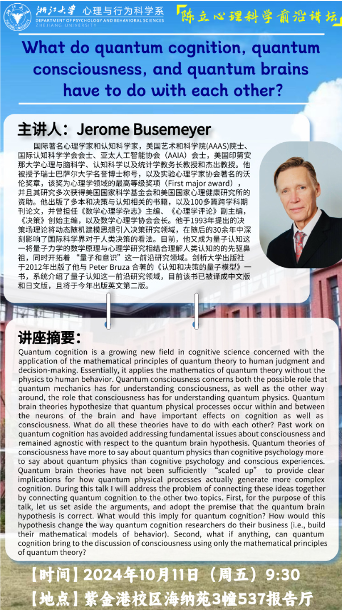
Speaker: Jerome Busemeyer
Jerome Busemeyer is an internationally renowned psychologist and cognitive scientist. He is a Fellow of the American Academy of Arts and Sciences (AAAS), the International Society for Cognitive Science, and the Asia-Pacific Artificial Intelligence Association (AAIA). He serves as a Professor and Distinguished Professor in the Department of Psychological and Brain Sciences at Indiana University, USA, and holds an honorary doctorate from the University of Basel, Switzerland. He is a recipient of the prestigious Warren Medal, the highest-level award in the field of psychology. His research has been consistently funded by the U.S. National Science Foundation and the National Institute of Mental Health. Professor Busemeyer has authored or co-authored numerous books and over 100 interdisciplinary journal articles on cognition and decision-making. He has served as Editor-in-Chief of the Journal of Mathematical Psychology, Associate Editor of Psychological Review, Founding Editor of Decision, and President of the Society for Mathematical Psychology. His 1993 work on Decision Field Theory profoundly shaped the international scientific community's understanding of human decision-making over the subsequent three decades. Currently, he is a pioneer in Quantum Cognition—an interdisciplinary field applying the mathematical principles of quantum mechanics to psychological research—and is also exploring the frontier of Quantum and Consciousness. Cambridge University Press published his co-authored book with Peter Bruza, Quantum Models of Cognition and Decision, in 2012, which systematically introduces this cutting-edge field. The book has been translated into Chinese and Japanese, with a second English edition forthcoming this year.
Quantum cognition is a growing new field in cognitive science concerned with the application of the mathematical principles of quantum theory to human judgment and decision-making. Essentially, it applies the mathematics of quantum theory without the physics to human behavior. Quantum consciousness concerns both the possible role that quantum mechanics has for understanding consciousness, as well as the other way around, the role that consciousness has for understanding quantum physics. Quantum brain theories hypothesize that quantum physical processes occur within and between the neurons of the brain and have important effects on cognition as well as consciousness. What do all these theories have to do with each other? Past work on quantum cognition has avoided addressing fundamental issues about consciousness and remained agnostic with respect to the quantum brain hypothesis. Quantum theories of consciousness have more to say about quantum physics than cognitive psychology more to say about quantum physics than cognitive psychology and conscious experiences. Quantum brain theories have not been sufficiently scaled up to provide clear implications for how quantum physical processes actually generate more complex cognition. During this talk I will address the problem of connecting these ideas together by connecting quantum cognition to the other two topics. First, for the purpose of this talk, let us set aside the arguments, and adopt the premise that the quantum brain hypothesis is correct. What would this imply for quantum cognition? How would this hypothesis change the way quantum cognition researchers do their business (i.e., build their mathematical models of behavior). Second, what if anything, can quantum cognition bring to the discussion of consciousness using only the mathematical principles of quantum theory?